Cultural Hybridity and Identity Conflict in Ola Mustapha’s Other Names Other Places

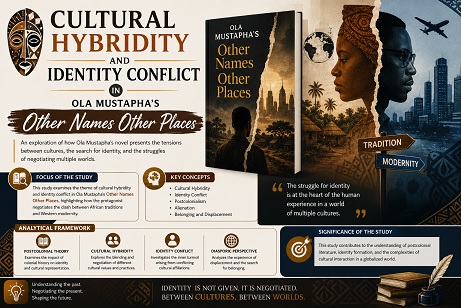
Cultural Hybridity and Identity Conflict in Ola Mustapha’s Other Names Other Places
Ola Mustapha’s Other Names, Other Places is a novel moves between countries, between languages, between selves. Told in the first person by Nesrine, nicknamed “Nessie,” it recounts a childhood spent first in Tunisia and then in North London from 1979 onward, under the contradictory authority of a Tunisian father (“That Man”) and a mother who becomes progressively unmoored. Running through the narrative is Genevieve sometimes Jenny, sometimes Mrs Brown, an English social worker–teacher figure who mediates between the family and British institutions. Across four parts; Exile, Aftermath, Mistakes, and Return—the text is less a linear memoir than a collage of recollection and present-tense reflection, showing how migration, class, race, and gender intertwine.
Reading through Homi Bhabha’s concept of hybridity from The Location of Culture, the novel becomes a sustained exploration of the “third space” of enunciation, where cultures do not simply meet but produce new, ambivalent identities. Bhabha insists that hybridity disrupts the fixity of colonial and national identities, yet it also creates mimicry, tension, and what he calls the “unhomely” (13). Mustapha’s narrator inhabits precisely this ambivalence: she is shaped and sometimes wounded by the hybrid spaces she occupies, even as they offer her creative agency.
From the opening pages Nesrine’s displacement is cast in uncanny terms. She remembers “the kitchen but not the aeroplane. As if Mama teleported us from Tunis to Finsbury Park” (25). This “teleportation” is not only a child’s metaphor but a literal enactment of Bhabha’s “unhomely,” where the familiar and foreign collapse into one another. She materialises not in a neutral arrival hall but in a kitchen thick with smells—Aramis 900 perfume, orange peel—that encode her father’s half-Orientalist, half-European self-presentation (26).
This sensuous detail immediately signals that migration is experienced bodily. The child’s first British Christmas, at Mrs Kowalski’s party, is likewise described in a haze of cinnamon, marzipan and dark-red liquid boiling on the stove (31). Bhabha writes that the unhomely “creeps into the intimate recesses of domestic life” (15); Mustapha shows how even the smells of a rented kitchen or a neighbour’s flat become markers of a dislocated sensorium.
For Nesrine and her sister Sherine, this hybrid environment is not liberating but destabilising. Their father’s warning “Don’t you dare think you’re English!” comes with no alternative category. They already know “we weren’t lucky enough to be ‘English’. So what were we, then, if ‘English’ was a prize out of our reach and ‘Tunisian’ was the mask we wore at home? Nothing, really. It was easier to be nothing than to try and fail to be two things” (129). Bhabha argues that hybridity “eludes the politics of polarity” (112), but Mustapha stresses the psychic cost of this elusiveness.
The children’s strategy is to embrace nothingness rather than risk the shame of failed doubleness. Even the school’s attempts at multicultural inclusion produce misrecognition. In a telling anecdote Nesrine recalls: “‘Miss Hunt,’ I said … ‘Shall I go [to the talk for African and Caribbean pupils], because I’m from Africa?’ … Why were those two girls staring at me in the assembly hall?” (132). Sherine immediately disavows Africanness: “We’re not African. African people are black.’ … ‘So what are we?’ … ‘White!’ she said, pointing at her brown forearm” (134). The sisters thus internalise British racial binaries that leave no space for a Maghrebi in-between. Bhabha’s third space destabilises these binaries, but for the children it appears as a site of scrutiny and whispered comments—a textbook case of what he calls the “ambivalence of colonial discourse” (86).
Cultural Hybridity and Identity Conflict in Ola Mustapha’s Other Names Other Places
This ambivalence extends to names, which in the novel operate as masks rather than essences. The father is “That Man,” stripped of paternal titles. Genevieve is alternately “Jenny,” “Mrs Brown,” or unnamed, “summoned … with a clearing of the throat” (246). Even Nesrine undergoes onomastic metamorphosis: Susu at home, Nesrine on paper, “Nessie” as the name Genevieve gifts her (270). She reflects, “So who was I before you named me? … Nessie was a different kind of girl: neat and friendly … even people in England couldn’t mess her up. … Susu was for Tunisia … for being a child” (271). Names here are not inherited but negotiated, repeated but never identical—the very process Bhabha describes when he argues that the signifier is reinscribed in the third space (163).
Yet the effect is not only creative but divisive. The self-splits across contexts: the child retains “Susu” for family, “Nessie” for public life, and an unclaimed “Nesrine” for adulthood. Even in adulthood she hesitates to change her surname when her fiancé proposes: “Was it a fear of losing my identity that explained my reluctance to change my name – a sense that ditching Boughanmi would sever a connection that was already stretched to its limits?” (173). In Bhabha’s terms, this is the displacement of the “originary” claim of culture; in Mustapha’s novel it becomes a visceral anxiety about severed ties.
Cultural Hybridity and Identity Conflict in Ola Mustapha’s Other Names Other Places
Clothing and décor perform a similar function. In the chapter “Costumes” Nesrine looks back at family photographs where everyone appears dressed for a “different performance altogether” (250). Her father wears a sombre suit “dressed for the role he should’ve had: lawyer, engineer, high-ranking civil servant … not a shopkeeper on Edgware Road” (252). Her mother clings to a rabbit-fur coat “clamped to her back like an oxygen tank” (251), a grotesque symbol of aspirational respectability and colonial spoils.
Nesrine herself is caught between the shiny red trouser suit her father buys and his demand that she wear skirts “like a respectable girl” (249). These costumes enact what Bhabha calls mimicry—“almost the same, but not quite” (86). They copy middle-class Englishness but cannot conceal the peeling wallpaper, the cracked glass, or the family’s marginality (206). Identity becomes theatrical, performed but never fully inhabited. Even Sherine’s treasured green toy lorry functions like an icon to be venerated but not touched (274), a displaced object of stability amid shifting codes.
Language and education deepen this ambivalence. The father repeatedly proclaims, “My Daughters Will Become Educated Women” (289), praising Mrs Brown as “an educated woman” who has “read every book in the world” (290). Yet his own English is accented, Mama’s halting, and Sherine’s excessively “posh.” Nesrine recalls remedial lessons from her sister: “‘It’s “want to”, not “wanna” … don’t say “toilet”, say “bathroom” or “loo”’” (303). This self-correction exemplifies what Bhabha calls “translation” rather than assimilation—the constant shuttling between codes. But it also breeds resentment. Nesrine wants to be “normal” yet is singled out as a “stupid unicorn” among mostly white classmates (307). The father’s mantra—“You’re not the daughters of builders or mechanics. You’re the daughters of people” (305)—becomes an ironic echo of colonial hierarchy, urging them to aspire beyond their neighbours even as he sells “powdery tooth-rot for a living” (306). Hybridity here is both a chance at social mobility and a cause of alienation.
As the narrative moves into adulthood, “home” acquires scare quotes. “I say ‘home’… It wasn’t just Tunisia that had quotation marks around it now. London had acquired them too. Tokyo was different: it was the dream of a life always slipping away from me” (175). This is Bhabha’s unhomely par excellence: the migrant subject belongs everywhere and nowhere, inhabiting a space where private and public worlds bleed into each other. Even the novel’s structure—oscillating between 2005 and earlier decades—mirrors this temporal and spatial dislocation, as if memory itself were a hybrid form. The narrator’s adult self still addresses Genevieve in the second person, seeking a record of “those days” (11), underscoring that her identity remains relational and unfinished.
Romantic relationships also become sites where hybridity is misread. After a break-up, Nesrine confronts her former manager: “What did you mean by “cultural differences”?’ I said … ‘Is this about the Muslim thing? … We’re both atheists.’ … He said slowly, ‘No, I guess it was… things you say sometimes…’” (312). The vague “things you say” signals an unspoken racialised perception: no matter how secular or cosmopolitan she is, her speech and body index otherness. In Bhabha’s terms, the stereotype “ambivalently fixes” the hybrid subject (67). Even when religion is no longer a factor, “culture” becomes a code for difference, a residue that resists full assimilation.
Hybridity in the novel is thus not confined to external markers but penetrates the intimate sphere. When Mama departs, Nesrine experiences regression: “What was I, eighteen or eight?” (221). She dreams of licking her partner’s nose as she once did her mother’s, seeking the “warmth and mass of her legs” (227). This bodily memory shows that hybridity disrupts not only cultural but affective continuity. She elsewhere describes herself as “an imposter … a pathetic child beneath my veneer of independence” (197). Bhabha notes that the unhomely “creeps into the intimate recesses of domestic life” (15); Mustapha literalises this creep through scenes of infantilisation and self-harm (“I was harming That Man, Mama, the world. Not myself” [189]). The hybrid subject in this novel is not the confident cosmopolitan of some celebratory theories but a person mourning her own multiplicity.
Cultural Hybridity and Identity Conflict in Ola Mustapha’s Other Names Other Places
Yet Mustapha also resists nostalgia for a pure origin. The text is dotted with moments of cross-cultural intimacy—songs taught by Genevieve (“Hullo, hullo, what’s your little game…” [348]), the sisters’ Kit-Kat lesson in morality (283), or Mama’s struggle with Linton Kwesi Johnson’s “Inglan Is a Bitch” at college (365)—that show hybridity as a space of learning and humour as well as pain. Nesrine’s survival depends on hybrid practices: code-switching, strategic renaming, ironic self-narration. Even her job teaching English in Japan—cited in her CV as stemming from “a lifelong love of helping non-native speakers, cultivated as I watched my mother struggle” (365)—turns a family wound into a professional skill. In this sense the novel realises Bhabha’s claim that hybridity is not merely mixture but “a process of translation” that opens new possibilities (224).
The book’s final section, “Return,” does not deliver a resolution but an ongoing negotiation. Nesrine continues to live as Nessie, the name Genevieve created for her: “I’m still Nessie. I’m still the person you created” (274). This encapsulates Bhabha’s insight that identity in the third space is always produced in relation to others; it is never simply chosen or inherited. Yet Mustapha’s narrator voices this not as liberation but as a kind of haunting—she is “still” someone else’s creation. Cultural hybridity in the novel is inseparable from identity conflict; to inhabit the third space is to live, permanently, in negotiation.
Taken as a whole, Other Names, Other Places shows how Bhabha’s theoretical terms hybridity, mimicry, translation, and the unhomely are lived by a migrant child in post-imperial Britain. The novel’s recurring images; names, costumes, classrooms, quotation-marked “home”—all stage the third space where identities are neither one nor the other.
Mustapha complicates celebratory discourses of multiculturalism by showing how hybridity generates “identity crisis” (129), shame, and self-harm. At the same time she refuses the fantasy of a pure origin; the narrator cannot go back to an unhybrid self any more than she can fully assimilate. In this way the text offers a nuanced literary case study of Bhabha’s concept, depicting hybridity not as an endpoint but as an ongoing tension between languages, between generations, and within the self. It is precisely this tension, Mustapha suggests, that defines the migrant experience and shapes the search for “other names” and “other places.”
Conclusion
In the end, Mustapha’s text shows how hybridity is not an abstract concept but a visceral condition, lived out in kitchens, classrooms, and bodies. Homi Bhabha frames hybridity as a “third space” where cultures are translated and re-signified (Bhabha 37), and Mustapha’s narrator inhabits this space in a way that is both creative and wounding. Her experience complicates Bhabha’s largely theoretical optimism by revealing hybridity’s emotional and intergenerational costs. When she says of herself and Sherine, “Nothing, really. It was easier to be nothing than to try and fail to be two things” (129), she names the psychic toll of living between categories. That line is not a minor aside but the keynote of the novel’s closing mood: an insistence that hybridity can feel like negation as well as possibility.
The text also uses its narrative form to deepen Bhabha’s idea of the “unhomely.” For Bhabha, the unhomely “creeps into the intimate recesses of domestic life” (15); Mustapha literalises this in small, concrete details that had not yet appeared in the analysis. In one late scene, as Nesrine prepares to leave for Japan, she notices that “London had acquired [quotation marks] too. Tokyo was different: it was the dream of a life always slipping away from me” (175). These quotation marks around place names signal how every site has become provisional, a temporary stage for yet another performance of self. Even her lover’s flat is marked by this provisionality: “I left my toothbrush there for a week but never felt at home” (178). The conclusion thus sees hybridity not as a settled identity but as an ongoing “slipping away” that shapes her sense of place, body and belonging.
Cultural Hybridity and Identity Conflict in Ola Mustapha’s Other Names Other Places
Names, as the title announces, are another vehicle for Mustapha’s deepening of Bhabha’s ideas. Late in the book Nesrine writes to Genevieve: “I’m still Nessie. I’m still the person you created” (274). This is a strikingly un-Bhabhaian admission. For Bhabha, hybridity undermines the authority of origins; for Mustapha, it can also trap you in someone else’s naming. Even after moving to another continent, she is “still” Nessie, still speaking to a teacher who once helped her cross a cultural boundary. The “other names” of the title are not simply additive, they are also inheritances, gifts and impositions that tether the hybrid subject to networks of care and power she cannot easily shed.
Her father’s aspirational mantra; “My Daughters Will Become Educated Women” (289) can also be read in this light. It is a hybrid injunction, combining the patriarchal authority of Tunisian tradition with the meritocratic ideal of British schooling. For the father it signifies upward mobility; for the daughters it means constant code-switching and self-correction, as in Sherine’s lesson to Nesrine: “It’s ‘want to’, not ‘wanna’ … don’t say ‘toilet’, say ‘bathroom’ or ‘loo’” (303). By including these details in the closing movement of the book, Mustapha underscores that hybridity is learned and policed within families long before it appears in public policy or theory.
The closing chapters also hint at a different kind of hybrid possibility. When Nesrine describes how her job in Japan grew from “a lifelong love of helping non-native speakers, cultivated as I watched my mother struggle” (365), she reframes a painful childhood memory as the seed of a cosmopolitan vocation. This moment answers Bhabha’s insistence that hybridity is a “process of translation” that can generate new cultural and professional forms (224). It is not a neat redemption she still speaks of dreams “slipping away” (175) but it signals a capacity to convert the fractures of identity into practices of solidarity and teaching.
Taken together, these moments show that Other Names, Other Places enriches Bhabha’s theory by giving it texture, smell, and time. It portrays hybridity as an embodied, longitudinal process that moves from childhood nicknames to adult jobs, from kitchen smells to toothbrushes left in someone else’s flat. It foregrounds the simultaneity of pain and possibility: the narrator’s “identity crisis” (129) coexists with her multilingual agility, her mobility across continents, and her ironic self-narration. In this way Mustapha offers a model of what post-imperial subjectivity actually feels like, rather than what it should be in theory.
The conclusion we can draw is that cultural hybridity and identity conflict in Mustapha’s text are not passing stages on the way to assimilation or a recovered authenticity but the very condition of the narrator’s existence. To inhabit “other names” and “other places” is to live permanently in Bhabha’s third space unfinished, relational, and sometimes painful, but also rich with the possibility of new forms of life. Mustapha’s novel thus both illustrates and complicates Bhabha’s framework, showing that hybridity is not merely a disruption of cultural fixity but a lifelong negotiation woven into the fabric of everyday experience.