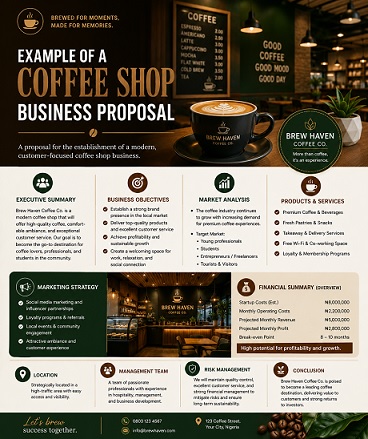
Example of a Coffee Shop Business Proposal
Opening a coffee shop is more than renting a space and buying an espresso machine. It is a carefully structured business venture that requires strategic planning, financial forecasting, operational clarity, and a compelling brand identity. Whether you are targeting an urban commercial district, a university environment, or a residential neighborhood, success depends on disciplined execution and realistic projections.
This coffee shop business proposal is structured to meet investor expectations, bank loan standards, and practical operational requirements. It is designed for entrepreneurs who want to launch a sustainable, scalable and profitable café business in 2026.
Executive Summary
Business Name (Proposed): Urban Brew Café
Business Type: Specialty coffee shop with light meals and pastries
Location: High-traffic commercial or university area
Target Market: Students, professionals, remote workers, young entrepreneurs
Startup Capital Estimate: ₦18,000,000 – ₦30,000,000 (depending on location and scale)
Projected Break-even Period: 12–18 months
Urban Brew Café aims to provide premium coffee beverages, artisan pastries, and a relaxed work-friendly atmosphere. The business will differentiate itself through quality sourcing, modern interior aesthetics, digital ordering systems, and community-driven engagement.
Business Description
The coffee shop industry has grown significantly due to:
- Rising urbanization
- Increasing coffee culture adoption
- Growth of remote work
- Youth-driven café lifestyle trends
- Demand for meeting spaces outside traditional offices
Urban Brew Café will operate as a mid-scale specialty coffee shop offering:
- Espresso-based beverages
- Cold brew and specialty blends
- Tea and non-coffee beverages
- Fresh pastries and light snacks
- Sandwiches and breakfast items
- Free Wi-Fi and work-friendly seating
The goal is to combine beverage excellence with a comfortable, social environment.
Industry Analysis
The coffee retail industry globally continues to expand. In Nigeria and other emerging markets, urban café culture is increasing due to:
- Growth in middle-class consumers
- Youth entrepreneurship
- Exposure to international café brands
- Social media influence
Key Market Drivers
- Lifestyle branding
- Convenience consumption
- Social experience economy
- Demand for premium beverages
- Rise in digital nomad culture
Despite competition from large chains, independent coffee shops thrive through niche positioning and localized brand identity.
Market Research and Target Audience
A successful coffee shop requires clear customer segmentation.
Primary Target Market
- University students
- Young professionals
- Freelancers and remote workers
- Entrepreneurs
- Middle-income urban residents
Secondary Target Market
- Corporate meetings
- Casual business meetings
- Social gatherings
- Tourists (location dependent)
Competitive Analysis
Competitors fall into three categories:
- Large coffee chains
- Local cafés
- Fast-food outlets selling coffee
Competitive Advantage Strategy
Urban Brew Café will differentiate through:
- Premium-quality beans
- Consistent taste profile
- Modern aesthetic interior
- Customer loyalty program
- Community events
- Instagram-worthy environment
Strong branding will reduce price sensitivity.
Products and Services
Beverage Menu
- Espresso
- Cappuccino
- Latte
- Mocha
- Americano
- Flat White
- Cold Brew
- Iced Coffee
- Specialty Seasonal Drinks
Non-Coffee Options
- Herbal teas
- Green tea
- Hot chocolate
- Fresh juices
- Smoothies
Food Offerings
- Croissants
- Muffins
- Donuts
- Sandwiches
- Pancakes
- Breakfast wraps
- Light salads
Pricing Strategy
Pricing will balance profitability with market competitiveness.
Example pricing model (adjustable by region):
- Espresso: ₦1,200
- Cappuccino: ₦1,800
- Latte: ₦2,000
- Sandwich: ₦2,500
- Pastry: ₦1,200 – ₦1,800
Average customer spend target:
₦3,500 – ₦5,000 per visit
Location Strategy
Location determines foot traffic and revenue.
Ideal features:
- High pedestrian traffic
- Proximity to offices or campuses
- Adequate parking
- Secure environment
- Good road visibility
Rental costs may range between ₦2,500,000 – ₦6,000,000 annually depending on city and area.
Equipment Requirements
Essential equipment includes:
- Commercial espresso machine
- Coffee grinder
- Refrigerator
- Freezer
- Display counter
- POS system
- Coffee brewing accessories
- Bakery oven (if baking in-house)
- Air conditioning
- Furniture and interior décor
Estimated equipment cost:
₦8,000,000 – ₦12,000,000 depending on quality.
Staffing Plan
Initial staffing structure:
- Café Manager
- Head Barista
- Assistant Barista (2)
- Kitchen Staff (2)
- Cashier
- Cleaner
Monthly payroll estimate:
₦800,000 – ₦1,500,000 depending on wage structure.
Marketing Strategy
Marketing will combine digital and physical channels.
Online Strategy
- Instagram marketing
- TikTok promotions
- Influencer partnerships
- Google Business listing
- Paid social media ads
- Email marketing
Offline Strategy
- Opening-day promo
- Loyalty cards
- Corporate partnerships
- Student discount programs
- Community events
Revenue Projection (Estimated)
Assume:
- 80 customers per day
- Average spend ₦4,000
Daily revenue:
₦320,000
Monthly revenue (26 operational days):
₦8,320,000
Annual revenue projection:
₦99,840,000
Actual results depend on location and operational efficiency.
Cost Structure Overview
Fixed Costs
- Rent
- Salaries
- Utilities
- Internet
- Security
Variable Costs
- Coffee beans
- Milk
- Pastries
- Packaging
- Cleaning supplies
Estimated monthly operational expenses:
₦4,000,000 – ₦6,000,000
Profitability Estimate
If monthly revenue averages ₦8,000,000 and expenses total ₦5,000,000:
Estimated monthly gross profit:
₦3,000,000
Break-even likely within 12–18 months depending on initial capital.
Risk Analysis
Common risks include:
- High rent costs
- Poor location choice
- Inconsistent product quality
- Poor staff training
- Low customer retention
- Economic downturn
Mitigation strategies:
- Long-term lease negotiation
- Quality control training
- Supplier contracts
- Diversified product offerings
Legal Requirements
Depending on jurisdiction, requirements may include:
- Business registration
- Tax identification number
- Food handling certification
- Health inspection approval
- Fire safety compliance
Compliance ensures operational sustainability.
A BUSINESS PROPOSAL
PRESENTED BY
EMEM ETEFIA
TO
THE HEAD OF OPERATION
SIGNATURE BY ROYALTY HOTEL, G-LINE, PLOT 48, EWET HOUSING ESTATE
Executive Summary:
Signature by Royalty Hotel is seeking a manager to run a coffee shop at Signature by Royalty Hotel, G-Line, Plot 48, Ewet Housing Estate. Committed to delivering a superlative coffee experience, we aim to position ourselves as a premium destination that seamlessly blends quality, ambiance, and exceptional customer service. Our endeavor is to become the preeminent choice for discerning coffee enthusiasts and local residents.
Business Description:
Signature by Royalty Hotel, G-Line, Plot 48, Ewet Housing Estate is poised to emerge as a comprehensive, high-end coffee establishment, presenting an array of premium coffee blends, artisanal beverages, and thoughtfully curated locally sourced snacks and pastries. Our objective is to cultivate a warm and inviting environment conducive to socializing, remote work, and leisurely pursuits.
Objectives:
Establish Signature by Royalty Hotel, as the undisputed coffee destination in G-Line, Plot 48, Ewet Housing Estate, Uyo.
Cultivate a devoted clientele through the delivery of unparalleled service and premium offerings.
Positively impact the local community by prioritizing local sourcing and actively supporting community initiatives.
Market Analysis:
Conduct an exhaustive analysis of the local coffee market, identifying competitors, profiling target demographics, and discerning potential avenues for strategic differentiation. Highlight perceived market gaps that Signature by Royalty Hotel is strategically poised to address.
Business Model:
Articulate a robust business model encompassing revenue streams, pricing strategy, and comprehensive financial projections. Provide a meticulous breakdown of startup costs, ongoing operational expenses, and anticipated profitability over the initial operational years.
Marketing Strategy:
Lay out a comprehensive marketing strategy designed to forge customer engagement and foster brand resonance. This may include targeted social media campaigns, strategic local partnerships, innovative loyalty programs, and flyers.
Personal Vision
Coffee business of recent is projected as one of the lucrative venture within the environs of Uyo and as the manager of the coffee shop, I will employed a systemic approaches to make the place outstanding and change the ambiance so it fits the season, time and day because people respond to environment. This will make my coffee shop more welcoming with a change in décor; lighting, music and updated menu base on what costumers experience else way.
As the manager of this coffee shop, I will employ all the necessary media space to advertise this business to potential customers within the ambiance of Uyo. To strive for more profit in the business. Personal orders and distance delivery will be done through the services of a dispatch rider to help boost the sales of the coffee.
In terms of staffing, I will like to run a shift pattern of staffing to enable effective work done. For the coffee shop assistance, an estimated monthly salary of ₦ 35, 0000 will be paid.
From my personal observation, I have noticed some unauthorized entering of the coffee shop by staff. In my dispensation as the manager, movement in and out of the shop will be restricted and proper account for both material, equipment and human resources will be properly accounted for.
Business Settlement Terms and Condition
In terms of the funds, 6 months will be used to study the financial strength of the business so as to be able to determine who will handle the funds; both capital and profit. Specifically, within the six months, I will be able to know if I will be the one paying the management or the management will be the one paying me and the staff under me. Reasons being that within this period I will be able to assess the financial strength of the shop but that does not mean that I will relax in my duty and responsibility.
Financial Projections:
Present a granular financial outlook, encompassing startup capital requirements, revenue forecasts, and profit margins. Offer a compelling narrative on the financial viability and prospective return on investment for potential stakeholders.
Items that will be needed shall be;
- White Coffee (Cobizco Pre-Mix 3 in 1 White Coffee 600 g)
- Cappucino Coffee
- Nescafe sachet
- Nescafe Breakfast 3 In 1 Sachet 25 g x10
- Lavazza
- Nescafe Gold Blend Espresso Coffee 95 g (Glass Bottle)
- Espresso coffee
Tea needed will be;
- Lipton Tea
- Green Tea
- English Breakfast
- Milo and hot chocolate
Also trending special tea (Arabian tea)
Popcorn Recipient
- Raw corn
- Butter
- Groundnut Oil
- Blended sugar
- Powder milk
Snacks
- Cookies
- Meat pie
- Egg roll
- Puff puff
- Chicken pie
- Fish pie
- Shawarma
- Pizza
Beverages
- Soft drinks
- Water
- Energy drinks
Equally, Fruit juice may be introduces such as;
- Watermelon juice
- Pineapple juice
Staffing
A sales boy will be needed to assist in carrying out the day-to-day running of the shop.
Equipment
- Micro system
- Teller Printer
- Point of sale machine (POS)
- Point of sale printing paper
- Stapler and stapling pin
- Record book
- Complimentary cards
- Design and printing of menu templates
- Snacks bags , Popcorn bags
- Tea mock
- Tea spoons
- Disposable coffee cups
- saucer plates
- trays
- dessert plates
- cutleries
- serviette
- water and juice glasses
- tumbler for Arabian tea and flacks
- tea pot and milk pot
- brown and white sugar
- honey
- powder and liquid milk
- electric kettle and jug
- white napkin for cleaning of glasses
- ice bucket
- bottle openers
- sugar pots
- honey pots
- toothpick
Maintenance
The coffee shop will be repainted to attract costumer(s) attention which will also serves as advertisement for the coffee business
Conclusion recommendations
High level of consistency in providing the needed services and various brands of product for costumer(s) consumption will be needed from the management.
Detailed Startup Cost Breakdown
Below is a realistic mid-scale startup estimate (adjustable based on location and ambition level).
1. Premises and Renovation
- Rent (1 year advance): ₦3,500,000
- Renovation and interior finishing: ₦4,000,000
- Branding and signage: ₦800,000
Subtotal: ₦8,300,000
2. Equipment and Furniture
- Commercial espresso machine: ₦3,500,000
- Coffee grinder (2 units): ₦900,000
- Refrigerator and freezer: ₦1,200,000
- POS system and software: ₦600,000
- Furniture (tables, chairs, sofas): ₦2,000,000
- Air conditioning and ventilation: ₦1,000,000
- Display counter and shelving: ₦800,000
Subtotal: ₦10,000,000
3. Initial Inventory
- Coffee beans (bulk supply): ₦500,000
- Milk and beverages stock: ₦300,000
- Pastries and ingredients: ₦400,000
- Packaging and disposables: ₦250,000
Subtotal: ₦1,450,000
4. Licensing and Registration
- Business registration: ₦100,000
- Health and safety certification: ₦150,000
- Local permits and inspection: ₦200,000
Subtotal: ₦450,000
5. Marketing and Launch Campaign
- Social media ads: ₦300,000
- Influencer partnerships: ₦400,000
- Opening event: ₦300,000
Subtotal: ₦1,000,000
Estimated Total Startup Capital
₦21,200,000 – ₦30,000,000
(Depending on location scale and branding ambition)
Monthly Operating Expense Projection
Fixed Costs
- Rent (if paid monthly equivalent): ₦300,000
- Staff salaries: ₦1,200,000
- Electricity and utilities: ₦400,000
- Internet and subscriptions: ₦80,000
- Security and cleaning: ₦150,000
Total Fixed: ₦2,130,000
Variable Costs
- Coffee beans and milk: ₦800,000
- Pastries and food ingredients: ₦700,000
- Packaging supplies: ₦200,000
- Marketing (ongoing): ₦200,000
Total Variable: ₦1,900,000
Total Monthly Operating Cost
Approximately ₦4,000,000 – ₦5,000,000
3-Year Financial Projection
Year 1
- Revenue: ₦90M – ₦110M
- Operating Cost: ₦60M
- Estimated Gross Profit: ₦30M – ₦50M
- Focus: Market penetration and brand awareness
Year 2
- Revenue: ₦120M – ₦150M
- Operating Cost: ₦75M
- Estimated Gross Profit: ₦45M – ₦75M
- Focus: Brand loyalty and operational optimization
Year 3
- Revenue: ₦180M+
- Expansion or second outlet launch
- Strong investor return potential
SWOT Analysis
A structured SWOT assessment strengthens investor confidence.
Strengths
- Growing coffee culture
- High youth demographic demand
- Repeat customer potential
- Strong branding opportunities
- Premium pricing margin
Weaknesses
- High initial capital requirement
- Dependency on skilled baristas
- Vulnerability to rent increases
- Perishable inventory risk
Opportunities
- Corporate catering contracts
- Coffee subscription model
- Franchise expansion
- Retail coffee bean packaging
- Event hosting
Threats
- Economic instability
- Competition from established chains
- Rising utility costs
- Supply chain disruptions
Branding and Identity Strategy
A coffee shop thrives on brand perception.
Brand Positioning
Urban Brew Café will position itself as:
- Premium yet accessible
- Youth-friendly but professional
- Social but productivity-focused
Visual Identity
- Minimalist logo
- Earth-tone color palette
- Wooden and industrial interior design
- Warm ambient lighting
- Branded takeaway cups
Instagram-friendly design increases organic marketing.
Supplier Sourcing Strategy
To ensure consistency and cost control:
- Partner with reliable coffee bean importers
- Negotiate long-term supply contracts
- Consider local roasters for freshness
- Source bakery ingredients in bulk
- Maintain backup suppliers
Consistency in taste builds customer loyalty.
Operational Efficiency Plan
Efficiency determines profitability.
Key systems:
- POS analytics for sales tracking
- Inventory management software
- Standardized recipe manual
- Staff training program
- Customer feedback tracking
Reducing waste increases margins.
Investor Pitch Framework
If seeking funding, present:
- Executive summary
- Market opportunity
- Competitive advantage
- Financial projections
- Break-even analysis
- Growth strategy
- Exit plan
Investors look for scalability and clear ROI.
Exit Strategy Options
A strong proposal includes exit planning.
- Sell equity stake after profitability
- Franchise brand expansion
- Sell business to hospitality group
- Convert into multi-location chain
Clear exit options attract investors.
Growth and Expansion Model
Once profitable, expansion paths include:
1. Second Outlet
Open in another high-traffic zone.
2. Coffee Cart Model
Mobile unit for events and corporate spaces.
3. Online Retail
Sell packaged coffee beans and merchandise.
4. Subscription Service
Monthly coffee bean delivery model.
Digital Strategy for 2026
Modern cafés must embrace digital systems.
- QR code menus
- Online ordering
- Loyalty app
- Digital payment systems
- Customer database marketing
Data-driven marketing improves retention.
Risk Management Plan
- Maintain 6-month emergency reserve
- Diversify supplier base
- Monitor daily sales reports
- Implement strict hygiene standards
- Insure key equipment
Risk control ensures sustainability.
Break-Even Analysis
Assuming:
- Monthly expenses: ₦5,000,000
- Average gross margin: 60%
Required monthly sales to break even:
Approximately ₦8,300,000
With consistent 80–100 customers daily, break-even is achievable within 12–18 months.
Final Conclusion
Launching a coffee shop in 2026 is both financially viable and culturally relevant if structured correctly.
Success depends on:
- Strategic location selection
- Financial discipline
- Strong brand positioning
- Operational efficiency
- Consistent quality control
With an estimated startup investment between ₦21M and ₦30M, and proper management, a mid-scale coffee shop can generate significant recurring revenue and scalable growth. A well-executed coffee shop is not just a beverage outlet. It is a lifestyle brand, a community hub and a scalable hospitality enterprise.