How to Write a Professional CV in 2026
Introduction
It is worthy to note that every CV is tailored to the job vacancy and the position the applicant wishes to applied for. The job market in 2026 is more competitive than ever. Employers receive hundreds, and sometimes thousands, of applications for a single vacancy. Whether you are applying for a government job, private-sector position, internship, graduate trainee role, remote opportunity, or international employment, your Curriculum Vitae (CV) remains one of the most important documents in the recruitment process.
A CV is often your first opportunity to make an impression on a potential employer. Before meeting you, conducting an interview, or reviewing your skills in detail, recruiters typically evaluate your CV to determine whether you deserve further consideration.
Unfortunately, many qualified candidates miss excellent opportunities because their CVs fail to communicate their strengths effectively. Some applicants use outdated CV formats, include irrelevant information, make avoidable mistakes, or fail to present their experiences professionally.
In 2026, employers are increasingly using Applicant Tracking Systems (ATS), artificial intelligence screening tools, and digital recruitment platforms to evaluate applications. This means job seekers must understand not only how to write a professional CV but also how to optimize it for modern recruitment technologies.
This comprehensive guide explains how to create a professional CV that stands out, attracts recruiters, and improves your chances of securing interviews.
Understanding the Purpose of a CV
Before writing a CV, it is important to understand its purpose. A professional CV is designed to:
- Present your qualifications
- Showcase your experience
- Highlight your skills
- Demonstrate your achievements
- Explain your professional background
- Convince employers to invite you for an interview
A CV is not simply a list of personal information.
Instead, it is a marketing document that presents you as a valuable candidate.
Why a Professional CV Matters More in 2026
Recruitment processes have evolved significantly. Modern employers often use:
- Online recruitment portals
- ATS software
- Digital screening systems
- Artificial intelligence tools
- Virtual hiring platforms
As a result, CVs must be:
- Well-structured
- Easy to read
- Keyword-optimized
- Professional in appearance
- Relevant to the target role
Candidates who fail to adapt to these modern requirements may struggle to progress beyond the initial screening stage.
What Makes a CV Professional?
A professional CV is characterized by:
Clarity
Information should be easy to understand.
Relevance
Only relevant information should be included.
Accuracy
Every detail must be correct.
Organization
Content should follow a logical structure.
Professional Presentation
Formatting should be clean and consistent.
Evidence of Value
The CV should demonstrate what the candidate can contribute to an organization.
Choosing the Right CV Format
One of the first decisions involves selecting the appropriate format.
Chronological CV
This format emphasizes work history. It is suitable for candidates with:
- Consistent employment records
- Progressive career growth
- Relevant experience
Functional CV
This format emphasizes skills rather than employment history. It may be suitable for:
- Career changers
- Recent graduates
- Individuals with employment gaps
Hybrid CV
This combines elements of chronological and functional formats.
Many professionals prefer this approach because it highlights both skills and experience.
Essential Sections of a Professional CV
A strong CV generally includes several key sections.
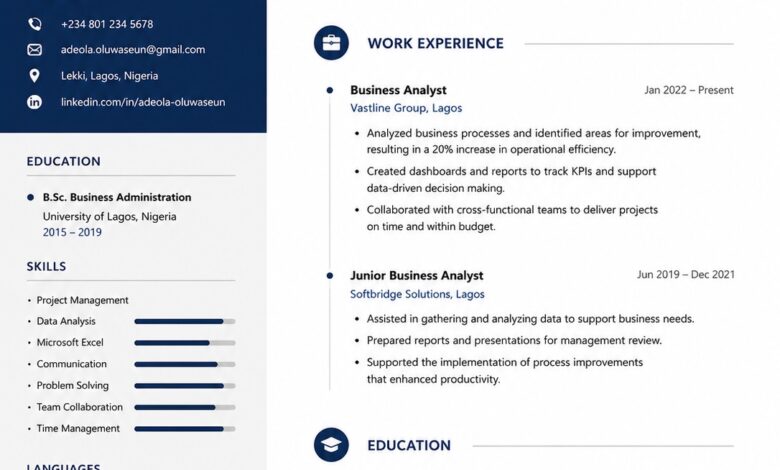
Personal Information
This section should contain basic details that allow employers to contact you. Include:
- Full name
- Telephone number
- Professional email address
- Location
- Professional networking profile (if applicable)
Avoid including unnecessary personal details.
Professional Profile
The professional profile is one of the most important sections of a modern CV. This brief summary should explain:
- Who you are
- Your experience level
- Key strengths
- Career focus
A strong profile immediately captures recruiter attention.
Career Objective vs Professional Summary
Many applicants confuse these two concepts.
Career Objective
Focuses on what the candidate wants.
Professional Summary
Focuses on the value the candidate offers.
Modern employers generally prefer professional summaries because they emphasize contributions rather than personal aspirations.
Educational Background
Education remains an important component of many CVs.
Include:
- Institution name
- Qualification obtained
- Graduation year
- Relevant achievements
Arrange information clearly and consistently.
Work Experience
For most employers, work experience is among the most influential sections.
Each role should include:
Job Title
Clearly identify the position.
Employer Name
Specify the organization.
Employment Dates
Provide accurate timelines.
Responsibilities
Summarize key duties.
Achievements
Highlight measurable accomplishments where possible.
Why Achievements Matter More Than Responsibilities
Many applicants make the mistake of listing responsibilities only.
For example:
“Managed customer service operations.”
A stronger approach is:
“Improved customer satisfaction rates through efficient service delivery.”
Achievements demonstrate impact.
Employers are interested in results.
Skills Section
The skills section should showcase abilities relevant to the target position.
Examples include:
Technical Skills
- Data analysis
- Software proficiency
- Programming
- Digital marketing
Professional Skills
- Communication
- Leadership
- Project management
- Problem-solving
Industry-Specific Skills
Skills directly related to the target field.
Tailoring skills to specific vacancies improves relevance.
Certifications and Professional Training
Certifications can strengthen a CV significantly.
Examples may include:
- Professional certifications
- Industry training programs
- Technical qualifications
- Leadership courses
Relevant certifications demonstrate commitment to professional development.
Volunteer Experience
Volunteer activities can add value, especially for:
- Recent graduates
- Career changers
- Individuals with limited work experience
Volunteer experience often demonstrates:
- Leadership
- Teamwork
- Initiative
- Community engagement
Professional Memberships
Membership in recognized professional associations may strengthen credibility.
Examples include industry bodies and professional organizations.
These memberships indicate ongoing engagement with the profession.
Projects and Portfolio Work
In 2026, project-based evidence is increasingly important. Candidates can showcase:
- Research projects
- Freelance assignments
- Technical projects
- Creative portfolios
Projects provide tangible evidence of competence.
The Importance of Keywords in Modern CVs
Many organizations use ATS software to screen applications.
These systems search for relevant keywords.
Candidates should therefore include terms commonly associated with their target roles. Examples include:
- Project management
- Data analysis
- Customer service
- Financial reporting
- Software development
Keyword optimization improves visibility during digital screening.
How to Tailor Your CV for Each Application
A common mistake involves submitting the same CV for every job.
Employers prefer customized applications. Tailoring may involve:
- Adjusting keywords
- Highlighting relevant experience
- Reordering sections
- Emphasizing specific achievements
Customized CVs often perform better than generic versions.
Common CV Mistakes That Cost Candidates Interviews
Many applicants unknowingly weaken their applications through avoidable errors.
Examples include:
Spelling Mistakes
Errors reduce professionalism.
Poor Formatting
Messy layouts affect readability.
Irrelevant Information
Unnecessary content distracts recruiters.
Exaggeration
False claims can damage credibility.
Outdated Information
Old details reduce relevance.
Why Simplicity Works Better Than Complexity
Many candidates believe elaborate designs create stronger impressions.
In reality, recruiters often prefer:
- Clean layouts
- Clear headings
- Readable fonts
- Logical organization
Simplicity improves readability and ATS compatibility.
Understanding Applicant Tracking Systems (ATS)
One of the biggest changes in modern recruitment is the widespread use of Applicant Tracking Systems, commonly known as ATS.
Many organizations now receive hundreds or thousands of applications for a single vacancy. Reviewing every application manually would be time-consuming and expensive.
To solve this challenge, employers use ATS software to filter and rank applications before recruiters review them.
This means your CV must be designed not only for human readers but also for digital screening systems.
How ATS Software Evaluates CVs
ATS systems typically analyze:
- Keywords
- Job titles
- Skills
- Qualifications
- Work experience
- Certifications
The software compares information in your CV against the requirements of the vacancy.
Candidates whose CVs closely match the advertised role often receive higher rankings.
Understanding this process can significantly improve your chances of progressing to the next recruitment stage.
ATS-Friendly CV Writing Tips
To improve compatibility with ATS software, consider the following recommendations.
Use Standard Headings
Examples include:
- Professional Summary
- Work Experience
- Education
- Skills
- Certifications
Complex or unusual headings may confuse screening systems.
Avoid Excessive Graphics
Many ATS platforms struggle to interpret graphics and visual elements.
Use Simple Formatting
Clean formatting improves readability.
Include Relevant Keywords
Review job descriptions carefully and incorporate relevant terminology where appropriate.
Save in Accepted Formats
Follow employer instructions regarding document formats.
Why Recruiters Spend Limited Time Reviewing CVs
Research consistently shows that recruiters often spend only a short period reviewing each application during initial screening.
This means your CV must communicate value quickly.
Important information should be easy to identify. Recruiters typically look for:
- Relevant experience
- Qualifications
- Skills
- Career progression
- Achievements
If these elements are difficult to locate, your CV may be overlooked.
The Importance of a Strong Professional Summary
The professional summary functions as your personal introduction. This section should immediately communicate:
- Professional identity
- Key expertise
- Experience level
- Career achievements
A compelling summary encourages recruiters to continue reading.
A weak introduction may reduce interest before the rest of the CV is reviewed.
Writing Achievement-Focused Work Experience
One of the most effective ways to strengthen a CV is to focus on achievements rather than responsibilities alone.
Consider the difference:
Responsibility Statement
“Handled customer complaints.”
Achievement Statement
“Resolved customer concerns efficiently, contributing to improved customer satisfaction.”
The second example demonstrates value and impact.
Employers are interested in results, not merely duties.
Quantifying Achievements Where Possible
Numbers add credibility and specificity. Examples include:
- Increased sales performance
- Reduced operational costs
- Improved efficiency
- Managed teams
- Coordinated projects
Quantifiable achievements help recruiters understand the scope of your contributions.
Building a Strong Skills Section
The skills section should align with employer expectations.
Many candidates list numerous skills without considering relevance.
A more effective approach involves selecting skills directly related to the target role.
Examples may include:
Technical Skills
- Data analysis
- Graphic design
- Accounting software
- Programming languages
Professional Skills
- Leadership
- Communication
- Negotiation
- Project coordination
Digital Skills
- Content management
- Social media management
- Cloud platforms
- Cybersecurity awareness
Relevance is more important than quantity.
How Recent Graduates Can Create Competitive CVs
Many graduates worry about limited work experience.
Fortunately, employers evaluate more than formal employment history. Recent graduates can emphasize:
- Academic achievements
- Internship experience
- Volunteer activities
- Student leadership positions
- Research projects
- Technical skills
These experiences often demonstrate valuable competencies.
Writing a CV Without Work Experience
Even candidates with no formal employment history can create strong CVs.
Focus on:
Academic Projects
Research and coursework can demonstrate practical abilities.
Volunteer Work
Volunteer activities often showcase teamwork and leadership.
Training Programs
Professional development activities indicate initiative.
Personal Projects
Independent projects can provide evidence of skills.
Employers frequently value demonstrated capability over employment history alone.
The Role of Certifications in 2026
Professional certifications have become increasingly important.
Employers often seek candidates who demonstrate commitment to continuous learning.
Relevant certifications may strengthen applications in areas such as:
- Information technology
- Project management
- Finance
- Human resources
- Digital marketing
- Data analytics
Candidates should prioritize certifications relevant to their target industries.
Why Digital Presence Matters
In 2026, recruiters often evaluate candidates beyond their CVs.
Professional online presence may influence hiring decisions.
Candidates should maintain professional standards across:
- Professional networking platforms
- Online portfolios
- Personal websites
- Industry communities
A strong digital presence can complement a well-written CV.
Tailoring Your CV for Different Industries
Different sectors prioritize different qualities.
Government Jobs
Often emphasize qualifications, compliance, and experience.
Corporate Roles
May prioritize achievements and measurable results.
Technology Positions
Frequently focus on technical skills and project portfolios.
Creative Industries
Often value portfolios and innovation.
Healthcare Roles
Typically emphasize certifications and professional competence.
Tailoring content improves relevance.
Common Myths About CV Writing
Several misconceptions continue to mislead job seekers.
Myth 1: Longer CVs Are Better
Length does not guarantee effectiveness.
Quality and relevance matter more.
Myth 2: Every Job Must Be Included
Only relevant experiences should be emphasized.
Myth 3: Fancy Designs Guarantee Success
Recruiters generally prioritize content over decoration.
Myth 4: One CV Works for Every Vacancy
Customization improves effectiveness.
Myth 5: Academic Qualifications Alone Secure Interviews
Employers evaluate multiple factors.
How to Make Your CV Stand Out
Standing out does not require exaggeration. Instead, focus on:
- Clear structure
- Strong achievements
- Relevant skills
- Professional presentation
- Targeted customization
Employers appreciate authenticity and clarity.
The Importance of Proofreading
A single error can undermine credibility. Before submission:
- Check spelling
- Review grammar
- Verify dates
- Confirm contact information
- Ensure consistency
Proofreading should never be rushed.
Creating a Professional Email Address
Your email address contributes to first impressions. Professional examples typically include:
- First name
- Last name
- Professional variations
Avoid informal or inappropriate email addresses.
Five Testimonies From Successful Job Seekers
Testimony 1: Samuel From Abuja
“I submitted the same CV for years without success. After learning how to tailor my CV to specific vacancies, I began receiving interview invitations regularly.”
Testimony 2: Esther From Lagos
“My old CV focused mainly on responsibilities. Once I started highlighting achievements and measurable results, recruiters became more interested in my applications.”
Testimony 3: Chukwuemeka From Anambra
“I underestimated the importance of ATS optimization. After updating my CV with relevant keywords, my response rate improved significantly.”
Testimony 4: Fatima From Kano
“As a recent graduate, I worried about lacking work experience. By emphasizing internships, volunteer work, and academic projects, I secured my first professional role.”
Testimony 5: Ibrahim From Kaduna
“Proofreading made a huge difference. I discovered multiple mistakes in my CV that I had overlooked for years. Correcting them improved my confidence and professionalism.”
Frequently Asked Questions
How many pages should a CV be in 2026?
The ideal length depends on experience level. However, relevance and clarity are more important than page count.
Should I include a photograph?
Follow employer requirements and industry norms when deciding whether to include photographs.
Is a CV different from a resume?
In many contexts, the terms are used interchangeably, although requirements vary across regions and industries.
Should references be included?
Many candidates provide references upon request rather than including them directly.
How often should a CV be updated?
CVs should be updated regularly to reflect new skills, qualifications, achievements, and experiences.
Expert Recommendations for Building a Competitive CV
Career experts commonly recommend:
- Customize each application.
- Focus on achievements.
- Maintain professional formatting.
- Use ATS-friendly structures.
- Highlight relevant skills.
- Include measurable results.
- Proofread carefully.
- Update regularly.
- Demonstrate continuous learning.
- Remain honest and accurate.
Future Trends in CV Writing
Recruitment continues to evolve.
Future trends may include:
Greater Use of Artificial Intelligence
AI screening tools are becoming increasingly common.
Skills-Based Hiring
Employers increasingly prioritize demonstrated skills.
Digital Portfolios
Online portfolios are gaining importance.
Data-Driven Recruitment
Organizations increasingly rely on analytics during hiring.
Continuous Learning Evidence
Candidates who demonstrate ongoing professional development may gain advantages.
Job seekers should remain adaptable.
Final Thoughts
Writing a professional CV in 2026 requires more than listing qualifications and work history.
Today’s employers seek candidates who can clearly demonstrate value, communicate achievements, and align their experiences with organizational needs.
A well-crafted CV serves as a personal marketing tool. It highlights strengths, showcases accomplishments, and creates opportunities for interviews.
By understanding modern recruitment expectations and applying the strategies discussed in this guide, job seekers can significantly improve their chances of success.
Conclusion
A professional CV remains one of the most powerful tools available to job seekers. Whether you are a student, graduate, experienced professional, freelancer, or career changer, the ability to present yourself effectively can influence career opportunities.
The most successful CVs are clear, relevant, organized, achievement-focused, and tailored to specific roles. They communicate value quickly and professionally while remaining compatible with modern recruitment technologies.
As competition for employment continues to increase in 2026, investing time in creating a strong CV is one of the smartest career decisions you can make.
Remember that your CV is often the first impression employers have of you. Make it professional, make it relevant, and most importantly, make it demonstrate why you are the right candidate for the opportunity.
A well-written CV may not guarantee a job offer, but it can open the door to the interviews and opportunities that move your career forward.