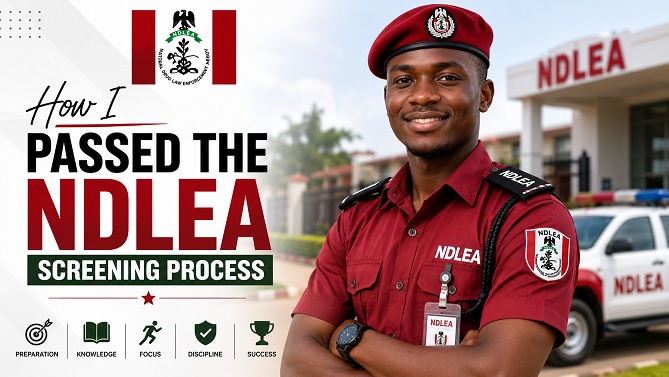
How I Passed the NDLEA Screening Process
Introduction
This is a true life story of Victor Akpan, A 24 years old man of Akwa Ibom state extraction which we interview on the 27th of May, 2026. His narration goes thus: When I received the invitation for the NDLEA screening exercise, I felt a mixture of excitement and anxiety. Like thousands of Nigerians who apply for recruitment opportunities every year, I knew that getting invited for screening was only one step in a much longer journey.
Many candidates assume that once they submit an application, the difficult part is over. However, the reality is quite different. The screening process is often where many applicants are disqualified due to mistakes that could have been avoided. Missing documents, poor preparation, misinformation, and lack of confidence have prevented many qualified candidates from progressing to the next stage.
My experience taught me that success in any recruitment screening is not solely about possessing academic qualifications. Preparation, attention to detail, discipline, and understanding the process are equally important.
In this article, I will share my complete experience of how I successfully passed the NDLEA screening process. I will explain the steps I took before the screening date, the challenges I encountered, the documents I prepared, the mistakes I avoided, and the lessons I learned along the way.
If you are preparing for an upcoming NDLEA recruitment exercise or any government agency screening in Nigeria, this guide can help you understand what to expect and how to improve your chances of success.
Understanding the Importance of NDLEA Screening
Before attending the screening exercise, I spent time researching the purpose of the process. The National Drug Law Enforcement Agency (NDLEA) is responsible for combating drug trafficking, substance abuse, and illegal drug-related activities in Nigeria. Because of the sensitive nature of its operations, the agency places great emphasis on recruiting individuals who demonstrate integrity, competence, discipline, and physical fitness. The screening exercise serves several purposes:
- Verification of qualifications
- Authentication of submitted documents
- Identity confirmation
- Physical assessment
- Character evaluation
- Medical suitability assessment
- General eligibility confirmation
Understanding these objectives helped me approach the exercise with the right mindset. Instead of seeing the screening as an obstacle, I viewed it as an opportunity to prove that I met the requirements needed to serve in the agency.
The Moment I Received My Screening Invitation
The day I received the screening invitation remains memorable.
After months of waiting following my application submission, I checked my email and saw a notification regarding the next phase of recruitment.
My excitement was immediately followed by concern because I knew the screening date was approaching quickly.
The invitation contained important instructions, including:
- Venue information
- Reporting time
- Required documents
- Dress code guidelines
- Verification procedures
- Other recruitment requirements
I carefully read the instructions multiple times.
One lesson I learned immediately was that many candidates fail simply because they do not pay attention to official instructions.
I made sure to create a checklist containing every requirement mentioned in the invitation.
Creating a Preparation Timeline
Rather than waiting until the last minute, I created a preparation plan.
I divided my preparation into several categories:
Document Preparation
I listed every document required for verification.
Physical Preparation
I worked on improving my fitness level.
Information Gathering
I researched NDLEA operations, structure, and responsibilities.
Mental Preparation
I prepared myself psychologically for long waiting hours and possible stress.
This organized approach helped reduce anxiety and ensured that nothing important was forgotten.
Gathering All Required Documents
One of the most critical parts of my preparation involved document verification.
I gathered both original copies and photocopies of all necessary credentials.
The documents included:
Birth Certificate
I carefully verified that the information matched details provided during my application.
Educational Certificates
I organized my academic credentials chronologically.
Local Government Identification
I ensured my local government certificate was available and properly arranged.
National Identification Documents
I carried valid identification for verification purposes.
Passport Photographs
I obtained recent passport photographs as instructed.
Application Printouts
I printed all recruitment-related documents and acknowledgments.
Other Supporting Documents
Any additional document requested in the invitation was included.
To avoid confusion during verification, I used separate folders and labeled each category.
This simple organizational strategy saved time during the exercise.
Why Document Accuracy Matters
One thing I observed during the screening process was that document discrepancies create serious problems.
Minor differences such as:
- Variation in names
- Incorrect dates of birth
- Mismatched signatures
- Missing documents
- Unclear photocopies
can attract unnecessary scrutiny.
Before attending the screening, I reviewed every document carefully.
Where necessary, I obtained supporting affidavits and relevant corrections.
This helped me avoid issues that affected some other candidates.
Preparing Physically for the Exercise
Many applicants focus solely on documents and ignore physical readiness.
I knew that recruitment agencies often value physical fitness, especially for operational roles.
Several weeks before the screening, I began a simple routine:
- Morning jogging
- Walking exercises
- Push-ups
- Stretching exercises
- Improved hydration
My goal was not bodybuilding.
I simply wanted to ensure that I appeared healthy, energetic, and capable of handling the demands of the exercise.
Maintaining Good Health Before Screening
As the screening date approached, I paid closer attention to my health.
I avoided activities that could result in injury.
I also ensured:
- Adequate sleep
- Proper nutrition
- Reduced stress
- Sufficient water intake
Many candidates underestimate the importance of appearing alert and healthy.
Fatigue can affect confidence, communication, and overall performance.
Learning About the NDLEA
Another step that helped me was studying information about the agency.
I familiarized myself with:
Agency Mandate
Understanding the role of the NDLEA in combating drug-related crimes.
Organizational Structure
Learning basic information about leadership and departments.
Core Values
Understanding the principles guiding agency operations.
Current Challenges
Studying issues relating to drug abuse and trafficking in Nigeria.
Although the screening focused mainly on verification, I believed having background knowledge would be useful if any questions were asked.
Preparing Mentally for Long Waiting Hours
One reality of large recruitment exercises is that waiting can be exhausting.
Thousands of candidates often arrive at the venue.
I anticipated this and prepared accordingly.
I developed patience by reminding myself that delays do not necessarily indicate problems.
This mindset proved valuable because the exercise involved significant waiting periods before verification.
Arriving Early at the Screening Venue
On the screening day, I arrived several hours before the scheduled reporting time.
This decision turned out to be one of the smartest choices I made.
Arriving early provided several advantages:
- Easier access to the venue
- Less confusion
- Better positioning in queues
- Time to settle down
- Opportunity to observe procedures
Candidates who arrived late appeared stressed and rushed.
Some struggled to organize documents while others worried about missing important announcements.
How I Passed the NDLEA Screening Process
First Impressions Matter
As I entered the venue, I reminded myself that recruitment officers observe more than documents.
Professional conduct matters.
I maintained:
- Respectful communication
- Proper posture
- Positive attitude
- Calm behavior
- Compliance with instructions
Recruitment exercises often evaluate candidates beyond academic qualifications.
Attitude can significantly influence perception.
Observations From Other Candidates
While waiting, I noticed several common mistakes among candidates.
Some individuals arrived without complete documentation.
Others had not arranged their credentials properly.
A few appeared unfamiliar with instructions contained in the invitation.
These observations reinforced an important lesson:
Preparation creates confidence.
Those who prepared thoroughly generally appeared more relaxed and organized.
The Document Verification Stage
Eventually, my group was called for document verification.
This stage involved careful examination of credentials.
Officials compared submitted information with original documents.
The process required patience because every detail was checked carefully.
Since I had organized my documents beforehand, I was able to present them quickly whenever requested.
This reduced delays and prevented unnecessary confusion.
How Organization Helped Me Stand Out
One recruitment officer commented positively on how neatly my documents were arranged.
Although this may seem insignificant, professionalism often leaves positive impressions.
Instead of searching through loose papers, I immediately produced requested documents.
This made the verification process smoother and more efficient.
Dealing With Nervousness During Verification
Despite my preparation, I still felt nervous.
However, I learned to manage anxiety by:
- Taking deep breaths
- Listening carefully
- Answering clearly
- Remaining patient
- Maintaining confidence
Recruitment officials interact with many candidates daily.
They generally appreciate individuals who communicate respectfully and follow instructions carefully.
The Importance of Honesty
During the process, I realized that honesty is essential.
Attempting to provide misleading information can create serious consequences.
Whenever clarification was required, I answered truthfully and directly.
Integrity is one quality recruitment agencies value highly.
Candidates should never attempt shortcuts that could jeopardize their chances.
Lessons I Learned During the First Half of the Screening Process
The first phase of the screening taught me several valuable lessons:
- Preparation reduces anxiety.
- Early arrival creates advantages.
- Organization improves efficiency.
- Patience is essential.
- Professional conduct matters.
- Physical appearance influences first impressions.
- Accurate documents prevent complications.
- Confidence grows from preparation.
Most importantly, I learned that success begins long before the actual screening day.
The habits developed during preparation often determine how candidates perform when the moment arrives.
What Happened After Document Verification
After successfully completing the document verification stage, I felt relieved. However, I quickly realized that passing document verification did not automatically guarantee success in the overall screening process.
The officials continued to observe candidates throughout the exercise. This taught me that recruitment screening is often a continuous assessment rather than a single event.
Many candidates relaxed after verification, but I remained focused.
I maintained discipline, followed instructions promptly, and avoided unnecessary conversations that could distract me from the process.
This mindset helped me remain prepared for every stage that followed.
Physical Appearance and General Conduct
One aspect many candidates underestimate is personal appearance.
Although the recruitment exercise was not a fashion competition, neatness and proper grooming created positive impressions.
I ensured that I appeared:
- Clean and well-groomed
- Properly dressed
- Respectful
- Disciplined
- Professional
Government agencies often seek individuals who can represent the institution positively.
Candidates should therefore present themselves in a manner consistent with the standards expected of public servants.
The Importance of Following Instructions
Throughout the screening process, officials repeatedly issued instructions.
Some candidates paid little attention, while others followed every directive carefully.
I noticed that candidates who ignored instructions frequently encountered problems.
Simple directives such as:
- Standing in designated areas
- Producing specific documents
- Maintaining orderly queues
- Completing forms correctly
were important.
I made it a priority to listen carefully whenever officials spoke.
This habit prevented mistakes that could have delayed my progress.
Managing Stress During the Screening Exercise
Long recruitment exercises can become mentally exhausting.
Several hours of waiting, standing, and moving between verification points can affect concentration.
To remain focused, I adopted a simple approach:
Staying Hydrated
I drank water regularly whenever opportunities arose.
Remaining Patient
I reminded myself that every candidate was undergoing the same process.
Avoiding Negative Discussions
Some applicants constantly spread rumors and misinformation.
I avoided such conversations because they increased anxiety.
Maintaining a Positive Mindset
Instead of worrying about things beyond my control, I focused on what I could influence.
This helped me stay calm and confident throughout the exercise.
How I Passed the NDLEA Screening Process
Common Mistakes I Observed Among Candidates
One advantage of arriving early and remaining observant was that I learned from the mistakes of others.
Several errors appeared repeatedly among candidates.
Incomplete Documentation
Some individuals failed to bring all required documents.
This created delays and, in some cases, disqualification.
Poor Document Arrangement
Candidates who carried disorganized files struggled during verification.
Late Arrival
A number of applicants arrived after important instructions had already been given.
Failure to Follow Instructions
Ignoring directives often attracted negative attention.
Overconfidence
Some candidates assumed they were guaranteed success because they possessed strong academic qualifications.
Unfortunately, recruitment exercises assess more than educational credentials.
Why Confidence Must Be Balanced With Humility
Confidence is important, but arrogance can become a disadvantage.
Throughout the screening process, I remained respectful toward officials and fellow candidates.
Whenever questions were asked, I answered confidently but politely.
Recruitment officers frequently interact with thousands of applicants.
Candidates who display maturity and professionalism often create better impressions than those who appear boastful.
Preparing for Possible Questions
Although the primary purpose of the exercise was verification, I prepared for possible questions.
My preparation covered:
Basic Information About the NDLEA
I studied the agency’s responsibilities and objectives.
Current Drug Abuse Challenges
I familiarized myself with discussions surrounding drug abuse and trafficking in Nigeria.
Personal Background Information
I reviewed details submitted during my application to ensure consistency.
Career Motivation
I reflected on why I wanted to join the agency.
This preparation helped me feel more confident whenever interaction with officials occurred.
Maintaining Consistency in Information
One lesson I learned is the importance of consistency.
Candidates should ensure that information provided during screening matches information submitted during application.
Areas requiring consistency include:
- Full name
- Date of birth
- Educational qualifications
- Contact information
- State of origin
- Local government area
Inconsistencies may trigger additional scrutiny.
I carefully reviewed my application details before attending the exercise.
Lessons on Patience and Discipline
The screening process taught me valuable lessons beyond recruitment.
Patience became one of the most important qualities.
There were moments when delays seemed frustrating.
However, I reminded myself that screening thousands of candidates requires time.
Discipline was equally important.
Candidates who remained orderly and cooperative generally experienced fewer problems than those who became impatient or confrontational.
The Role of Self-Confidence
Confidence played a major role in my success.
Many applicants become intimidated by the recruitment environment.
I learned that confidence grows from preparation.
Because I had:
- Prepared my documents
- Researched the agency
- Organized my credentials
- Planned my journey
- Reviewed application information
I felt more comfortable throughout the exercise.
Preparation transformed uncertainty into confidence.
What I Would Do Differently If I Were Starting Again
Looking back, there are several things I would improve.
Earlier Preparation
I would begin preparing documents even earlier.
Additional Physical Training
I would spend more time improving overall fitness.
More Research
I would deepen my understanding of recruitment procedures.
Better Travel Planning
I would make transportation arrangements further in advance.
Although my preparation was effective, continuous improvement is always possible.
How I Passed the NDLEA Screening Process
Key Factors That Helped Me Pass the NDLEA Screening Process
After reflecting on the entire experience, I identified several factors that contributed significantly to my success.
Thorough Preparation
Success began weeks before the screening date.
Attention to Detail
Careful review of documents prevented avoidable errors.
Discipline
Following instructions consistently proved beneficial.
Professional Conduct
Respectful behavior created positive interactions.
Positive Mindset
Remaining optimistic reduced stress.
Organization
Proper document arrangement improved efficiency.
Patience
The ability to remain calm throughout the process was valuable.
Practical Advice for Future NDLEA Applicants
If you are preparing for an upcoming NDLEA screening exercise, consider the following recommendations.
Read Every Instruction Carefully
Never assume you already know what is required.
Prepare Documents Early
Avoid last-minute rushes.
Organize Credentials Properly
Use labeled folders where possible.
Arrive Early
Punctuality demonstrates seriousness.
Dress Neatly
Present yourself professionally.
Stay Informed
Rely only on official recruitment information.
Remain Respectful
Treat officials and fellow candidates courteously.
Stay Calm
Anxiety often causes avoidable mistakes.
How Recruitment Screening Builds Character
One surprising lesson from the process was that recruitment exercises can strengthen personal development.
The experience improved my:
- Time management
- Organizational skills
- Patience
- Communication abilities
- Confidence
- Discipline
Even candidates who do not ultimately secure employment often gain valuable life lessons from the process.
How I Passed the NDLEA Screening Process
Five Testimonies From Successful Applicants
Testimony 1: Chinedu From Enugu
“I almost missed the screening because I waited until the last week to prepare my documents. Fortunately, I completed everything on time. My biggest lesson was that preparation should begin immediately after receiving the invitation.”
Testimony 2: Aisha From Kano
“I paid attention to every instruction in the invitation letter. Many candidates focused only on their certificates, but I ensured that every requirement was available. That preparation gave me confidence during the exercise.”
Testimony 3: Emeka From Anambra
“I arrived at the venue several hours early. This helped me avoid confusion and allowed me to organize myself properly before the screening began.”
Testimony 4: Fatima From Kaduna
“I spent time learning about the agency before the screening. Understanding its responsibilities helped me answer questions confidently and demonstrated genuine interest in public service.”
Testimony 5: Samuel From Rivers State
“My greatest advantage was discipline. I followed instructions carefully, remained patient throughout the exercise, and avoided unnecessary distractions. Those habits helped me complete the screening successfully.”
Frequently Asked Questions About NDLEA Screening
Is document verification important?
Yes. Document verification is one of the most critical stages of the recruitment process because it confirms the authenticity of candidate information.
Should candidates bring original credentials?
Candidates should always follow official instructions regarding required documents and verification requirements.
Is punctuality important?
Absolutely. Arriving early reduces stress and allows candidates to settle in before activities commence.
Does physical fitness matter?
For many recruitment exercises involving security and law enforcement agencies, physical fitness can be an important consideration.
Can candidates rely on social media information?
Official recruitment announcements should always be prioritized over rumors and unofficial sources.
Final Reflections on My NDLEA Screening Experience
Passing the NDLEA screening process was not the result of luck.
It was the outcome of preparation, discipline, patience, and attention to detail.
The experience taught me that success in competitive recruitment exercises often depends on more than academic qualifications. Candidates who prepare thoroughly, remain organized, follow instructions, and maintain a positive attitude place themselves in a stronger position to succeed.
For anyone aspiring to join the NDLEA or any government agency, my advice is simple: start preparing early, remain focused, trust the process, and never underestimate the value of discipline.
Every stage of recruitment presents an opportunity to demonstrate your readiness for service. The habits you develop before the screening often determine how you perform when the opportunity finally arrives.
If I could summarize my experience in one sentence, it would be this:
Passing the NDLEA screening process was not about being the smartest candidate—it was about being one of the most prepared candidates.
Conclusion
The NDLEA screening process can seem intimidating, especially for first-time applicants. However, candidates who approach the exercise with preparation, confidence, and discipline can significantly improve their chances of success.
My journey reinforced the importance of organization, punctuality, honesty, and persistence. By preparing documents properly, maintaining a professional attitude, staying informed, and following instructions carefully, I was able to navigate the screening process successfully.
As future recruitment exercises approach, remember that preparation is your greatest advantage. Begin early, stay committed, and focus on presenting the best version of yourself.
Success may not happen by accident, but with proper preparation and determination, it becomes much more achievable.